Origin story
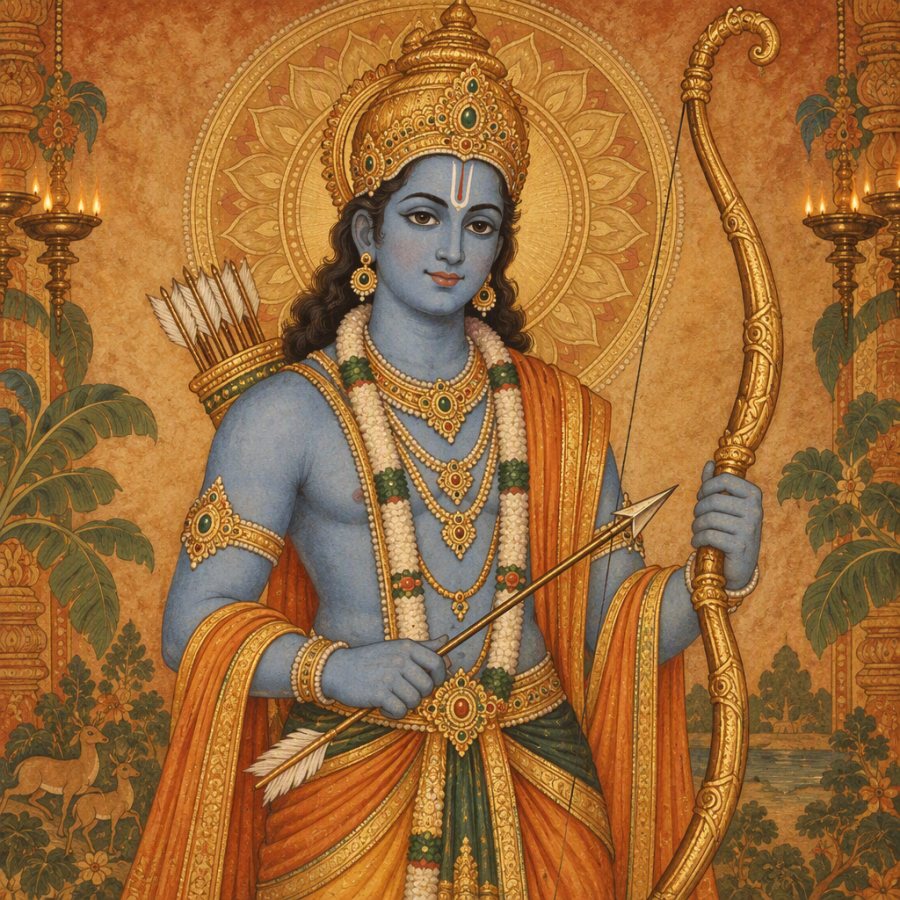
Rama, prince of Ayodhya, accepted fourteen years of exile to honour his father's word. With Sita and Lakshmana he lived in the forest, where Ravana carried Sita away to Lanka. Aided by Hanuman and the vanara army, Rama crossed the sea, defeated Ravana and returned to rule Ayodhya in the age remembered as Ram Rajya.
The Ramayana presents Rama as the model of dharma — dutiful son, faithful husband and just king. His bow and arrow stand for righteous resolve, and the whole epic is recited across India during Ramanavami and the Ramlila season. In Kerala his temples, such as Triprayar, preserve the solemn, protective character of the deity.
Source: Wikipedia: Rama — https://en.wikipedia.org/wiki/Rama
Symbolism
The bow and arrow represent righteous resolve; Sita stands for devotion and the earth.
Stotra
2
Sri Rama Rama Rameti
श्रीराम राम रामेति रमे रामे मनोरमे। सहस्रनाम तत्तुल्यं रामनाम वरानने॥
Śrīrāma Rāma Rāmeti Rame Rāme Manorame, Sahasranāma Tattulyaṃ Rāmanāma Varānane
Meaning — Repeating the name of Rama is equal to reciting a thousand names of the Lord, so declares the thousand-name recitation.
Recited for: Nama japa, protection
Rama Gayatri
ॐ दाशरथये विद्महे सीतावल्लभाय धीमहि। तन्नो रामः प्रचोदयात्॥
Oṃ Dāśarathaye Vidmahe Sītāvallabhāya Dhīmahi, Tanno Rāmaḥ Pracodayāt
Meaning — May we know the son of Dasharatha, may we meditate on the beloved of Sita. May Rama illumine our minds.
Recited for: Gayatri japa, harmony