Origin story
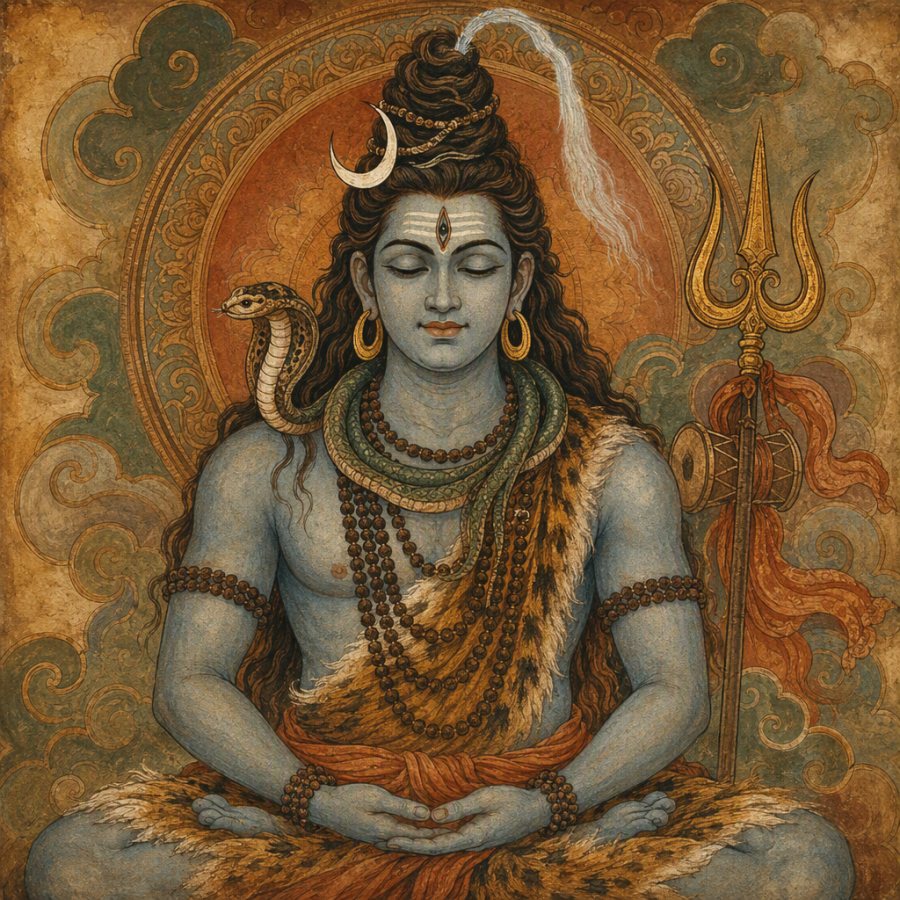
When Brahma and Vishnu quarrelled over who was supreme, Shiva appeared between them as a pillar of fire without beginning or end, and neither could find its limit. During the churning of the ocean he swallowed the Halahala poison to save the worlds, and Parvati held his throat still so that it turned blue — the name Neelakantha, the blue-throated one.
Shaivism honours Shiva as the lord who creates, preserves and dissolves the universe. He is worshipped as the lingam in the sanctum, as Nataraja in the dance of creation, and as the ash-smeared ascetic of Kailash. Kerala's Shivalayas keep the lingam at the centre of daily ritual, and Shivaratri is observed with night-long fasting, abhisheka and the chanting of his names.
Source: Wikipedia: Shiva — https://en.wikipedia.org/wiki/Shiva
Symbolism
The crescent moon, Ganga in his locks, the third eye, the damaru drum and the trishula represent time, purification, wisdom and the three gunas.
Mantra
2
Om Namah Shivaya
ॐ नमः शिवाय
Oṃ Namaḥ Śivāya
Meaning — I bow to Shiva, the auspicious and benevolent one. The five syllables are held to represent the five elements.
Recited for: Daily japa, inner purification, peace of mind
Maha Mrityunjaya Mantra
ॐ त्र्यम्बकं यजामहे सुगन्धिं पुष्टिवर्धनम्। उर्वारुकमिव बन्धनान्मृत्योर्मुक्षीय मामृतात्॥
Oṃ Tryambakaṃ Yajāmahe Sugandhiṃ Puṣṭivardhanam, Urvārukamiva Bandhanān Mṛtyor Mukṣīya Māmṛtāt
Meaning — We worship the three-eyed one who is fragrant and nourishes all beings. As the cucumber is freed from its vine, may we be liberated from death and not from immortality.
Recited for: Health, recovery from illness, protection from untimely death